
Bed banks are often described as accommodation wholesalers. That is true, but incomplete. Operationally, they sit in the middle of a fragmented global hotel supply chain. Financially, they sit in the middle of a complex web of collections, conversions, funding decisions, and supplier payouts across multiple entities, markets, and currencies.
The technological focus for many travel companies started with booking flows, and then gradually supplier settlement became a key focus – largely due to the explosion of virtual card use in the sector. Those are important foundations, but they only capture part of the picture. For bed banks in particular, the harder problem is often treasury: how cash is collected, where it sits, when it needs to move, in which currency, through which entity, and with what level of visibility and control.
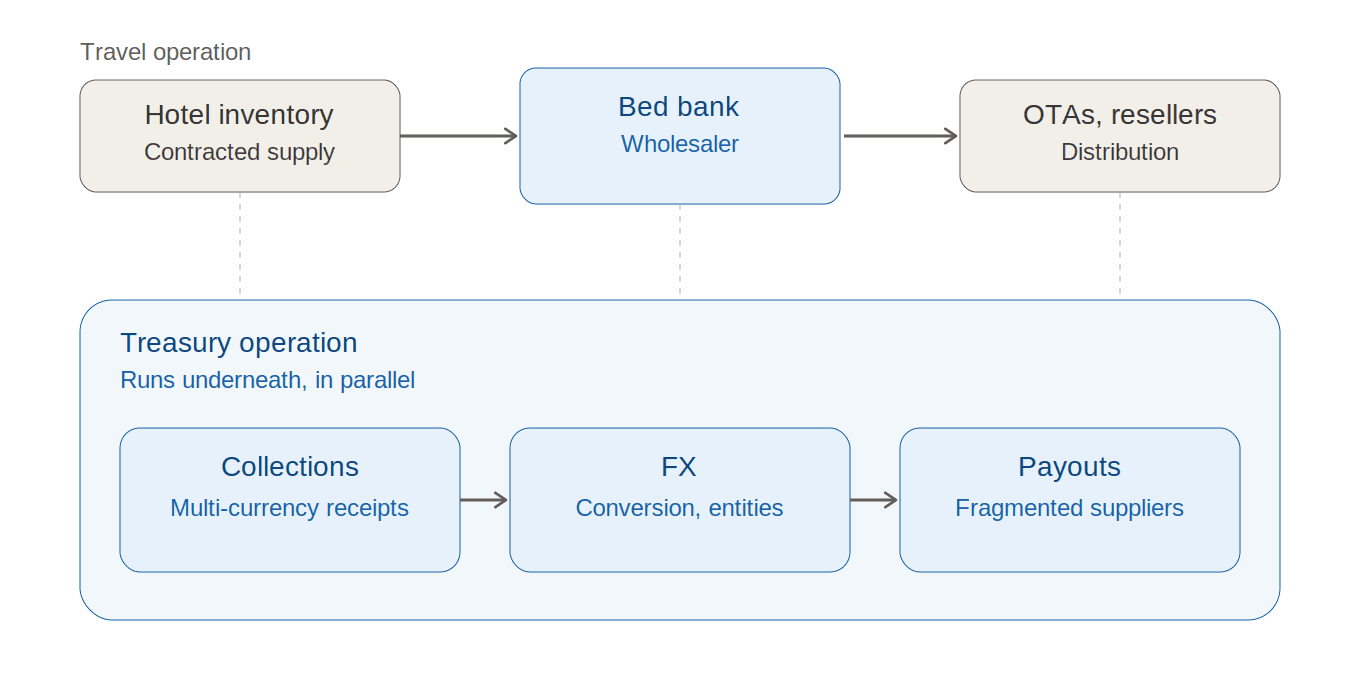
A bed bank is not just managing travel inventory, but rather managing a multi-currency balance sheet and a high-volume settlement engine simultaneously.
Why bed banks are financially more complex than they look
At a surface level, the model is straightforward. A bed bank contracts hotel inventory and distributes it to OTAs, tour operators, and other intermediaries. It pays one side of the market and collects from the other.
In practice, that creates several layers of treasury complexity.
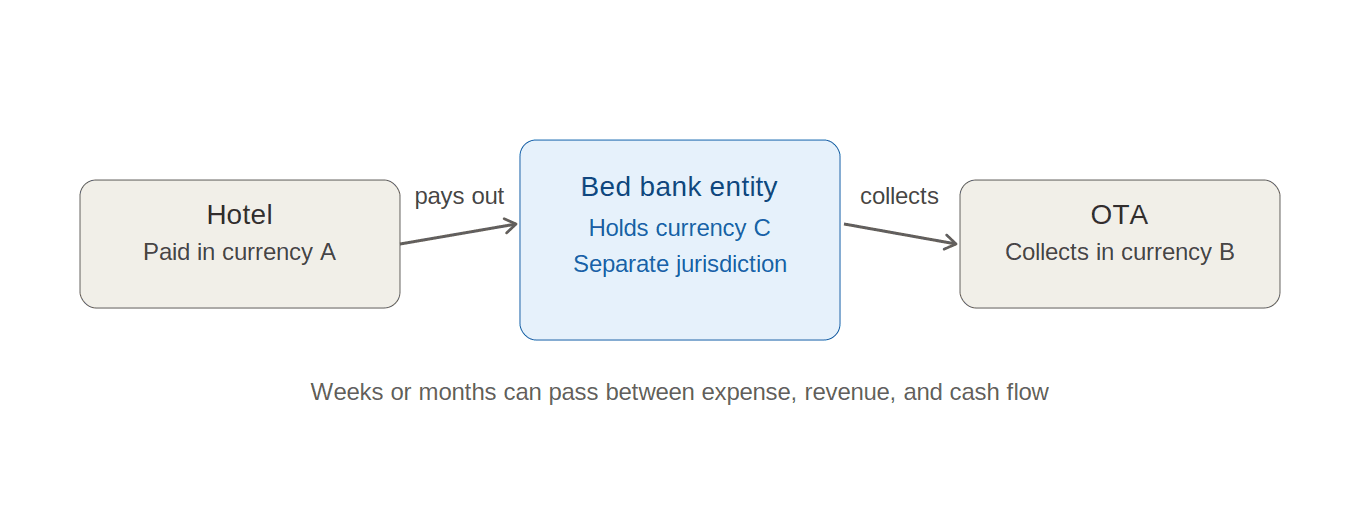
First, collections and payouts rarely happen in the same place or at the same time. A bed bank pays the hotel in one currency, collects from an OTA in another currency, and then holds funds in a third currency, possibly in another entity and jurisdiction. Weeks or months may pass between the initial expense, the recognized revenue, and the ultimate cash flow.
Second, the business is often exposed to a large number of counterparties. On the receivables side, that may include agencies, OTAs, resellers, and tour operators across multiple markets. On the payables side, it may include thousands of hotels and accommodation providers with different payment preferences, local banking requirements, and settlement terms.
Third, bed banks often operate through multiple legal entities and bank relationships. That creates a need to monitor balances, segregate flows, and move liquidity efficiently across the group without losing reconciliation control.
This is why bed banks tend to feel treasury pain as a combination of smaller pressures rather than one big problem: collections are fragmented across dozens of partners, bank accounts multiply faster than anyone intended, and FX exposure builds quietly between booking and settlement. Add in the reconciliation effort across entities and currencies, plus the operational friction of paying suppliers through third-party specialists, and the cumulative drag becomes real.
The real challenge is not sending money, but controlling the flow of funds
Travel businesses often talk about payments as if the core task is execution: can the business collect money and can it pay suppliers?
For bed banks, that framing is too narrow.
The harder question is whether the business has control over the flow of funds from end to end. Not just where money is received, but how quickly it's identified, whether it's converted at the right time and rate, and whether exceptions get resolved without someone chasing them down manually.
A bed bank with weak treasury infrastructure can still function operationally, but usually at a cost. Finance teams spend more time tracing receipts, working capital is managed less precisely, FX is handled reactively rather than strategically, and supplier payout processes become more manual than they need to be.
Collections are often more complex than supplier payments
Supplier payments get a lot of attention in travel because they are visible and operationally sensitive. Virtual cards have also made them an opportunity to generate rebates. But for many bed banks, collections deserve equal attention.
Receipts may come from a wide range of partners across markets, often with different remittance behaviors, settlement cycles, and reference quality. Some counterparties provide clean booking references. Others do not. Some settle exactly as expected. Others batch, net, delay, or partially pay.
That creates a familiar treasury problem: cash is arriving, but visibility is imperfect.
This is where virtual account structures can be genuinely useful as a treasury control mechanism. If incoming funds can be routed through virtual accounts structured by customer, market, entity, or corridor, the business gains a cleaner way to identify receipts and reconcile them without relying on one pooled account with inconsistent remittance data.
For a bed bank, the practical payoff is faster cash identification, less manual reconciliation, and fewer bank accounts to maintain in the first place.
FX risk sits at the heart of the bed bank model
Bed banks are often structurally exposed to FX even when it is not described that way internally.
A booking may be priced to a customer in one currency while the underlying hotel contract is denominated in another. Between payout and collection, exchange rates move. If the business is operating at scale across many source and destination markets, this becomes a recurring commercial issue.
The exchange rate itself matters less than the operational decisions underneath it: when to convert, which entity should hold which currency, and whether balances should be netted rather than moved.
Without a coherent treasury approach, FX management becomes fragmented. Commercial teams may own pricing logic, finance may own settlement, and treasury may only have partial visibility into the resulting exposure.
A more mature setup treats FX as part of the operating model. That does not necessarily mean sophisticated hedging in every case. Often it starts with better visibility, more deliberate currency account structures, and clearer control over when and how conversions occur.
Using a provider with integrated collections, currency management, and payout capability can empower treasury teams with visibility and control. Larger bed banks can also benefit from more sophisticated FX products – starting with rate reservation and evolving into forward contracts and more complex trading patterns.
Payouts are operational, but also strategic
Hotel payouts are usually treated as an accounts payable issue, but they're just as much a treasury issue.
The method, timing, and currency of a payout ripple outward — into supplier relationships, liquidity usage, and FX outcomes.
A fragmented supplier base means one universal payout approach is rarely optimal. Some suppliers are suited to card-based settlement. Others require local or cross-border bank transfer. Some markets reward early, predictable payment. Others are more tolerant of standard cycles.
From a treasury perspective, it’s important to make cost-efficient payouts, but the ability to do so from the right funding structure with the right degree of control is essential.
For bed banks, payout infrastructure should therefore be thought about in the same frame as collections and FX, not as a separate workflow. The more integrated those three components are, the easier it becomes to manage liquidity and reduce friction.
Why treasury management matters more as bed banks scale
A smaller business can often live with workarounds. A handful of bank accounts, manual spreadsheet tracking, reactive FX conversion, and exception-heavy reconciliation may be inefficient, but it’s still survivable.
As bed banks grow, complexity compounds faster than transaction count alone would suggest. More customers mean more incoming payment behaviours. More markets mean more currencies and more regulatory nuance. More suppliers mean more payout exceptions. More entities mean more trapped liquidity and more reporting demands.
At that point, treasury stops being a back-office support function and becomes a core enabler of scalable growth.
Where infrastructure can help without overcomplicating the model
Not every bed bank needs a highly engineered treasury stack from day one. But many need more structure than they currently have.
The most useful infrastructure solves practical problems first: virtual accounts that improve receipt identification, multi-currency structures that cut account sprawl, and payout capabilities that simplify settlement across a fragmented supplier base.

Bed banks are one of the travel subsectors where treasury infrastructure can have a measurable operational impact, particularly by improving control over collections, currencies, and supplier settlements into one connected model.
Want to learn more about how PingPong can help your business? Contact our team directly at travel@pingpongx.com.